From MK Bay Marina, Kitimat, we sailed down Verney Passage and around Gribble Island, where if you’re lucky you can spot a Spirit Bear (Kermode Bears) in one of the 2,000 creeks unique to the Great Bear Rainforest. As a result of a recessive white gene carried by 10% of black bears in this region, it turned 400 bears white (not Albino) and are totally sacred to the First Nations Communities who live side by side with them. The bears also remind them to be grateful because once upon a million years ago, their territory was covered in ice.
Two black bears can give birth to a Kermode if one of them carries the gene. The bears feed on wild salmon then leave the carcasses on the forest floor that turn into nutrients which move on to the trees and contribute to the growth of the forest. Dead or alive, wild salmon enriches the rain forest.
It was the peak of the salmon run season that runs from late August to September after they return from the ocean to spawn, and that’s why we were here. We navigated into what was like an oil painting made of decomposed nutrients from wild salmon that enriches towering Sitka and Spruce trees among other firs that are over a thousand years old where bears and wolves find shelter from rain clouds which were pretty relentless the week we were there. It rained endlessly, but it didn’t deter Humpback whales from having a good time, bald eagles watching napping and playful bears hunt for salmon, river otters dog paddling from one creek to the other, orcas and sea lions swimming by our boat and howling coastal wolves that kept us on our toes.
Day 1 – We left MK Bay Marina to Gribble Island via Verney Passage. Steller Sea Lions were swimming around Fishtrap Bay, Orcas, I finally got to see up close, dove in and out of the water. Nothing exciting on Gribble Island. The currents were too strong for salmon hunting so the bears were out of sight. It rained non stop, we spent the night at Bishop Bay, a popular hot spring spot.


Day 2 – We sailed around Gribble Island eagerly scouring the coastline for Spirit Bears at Fish Trap Bay. It was also sea wolf territory, a subspecies of the grey wolf. They are often elusive, rare to see and can swim! Our patience in the rain paid off as wolves howled with each other, so we set out towards the coast and watched a pack of sea wolves emerge from the forest. We heard them howl, wander around the coast and sit looking out at us for almost four hours until they slipped away. It was an out of the ordinary experience.
Humpback whales swam along as we sailed towards Cameron Cove at Princess Royal Island where we actively kept an eye out for a surprise encounter.


Day 3 – Weather forecast: Rain, fog, wind. We cruised down south to Ashdown Island, a popular destination for Humpback whales. We spotted a bunch of blows far away and Steller Sea lions hauling out on small islets with their pups, but we couldn’t go any further. The visibility was poor, so we went back to Cameron Cove at around noon for shelter and River Otter action. We chased them for over an hour as they swam along the coast line of Princess Island.
At 4pm, we left Cameron Cove and sailed up towards Whale Channel. The name gives it away, we stalked Humpback whales socialize and lunge feed for over an hour. We anchored at Cameron Cove.


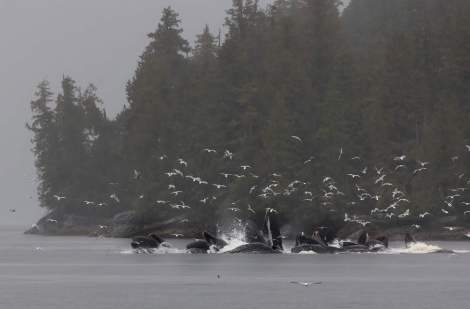
Day 4 – In the AM, we set out towards Whale Channel, down south to Ashdown Island and Campania Sound guided by Humpback whales from 10am to 5pm. They displayed all kinds of social behavior and activity you read about and never imagine to ever experience. They sang, splashed around and fed using various techniques. On a few occasions, a Fin whale covered in shark bite marks (second largest whale) surfaced. It was surreal and mysterious as we watched how seabirds sponge off Humpback whales for leftover fish. We took our cue from flocks of all kinds of seagulls circling by the coast until they formed a confetti like cloud over bubbling waters. Meanwhile underneath, one Humpback blows bubbles, the other makes feeding calls and then they all gather and lunge out of the water at the same time. When they feed on krill, they use a different bubble net feeding technique.
They did it over and over again, for over 40x. It felt like we watched it the first time every time.
Later in the evening, we anchored at Goat Harbour off Gribble Island. Next stop: Bears.
 CRAYSCAPE
What an amazing experience it must have been watching and being watched by sea wolves. It gives me the chills just thinking about it. So special. Wishing you a wonderful 2025 with many wonderful adventures dotted along the way, Sarah.
Thanks Jolandi, it was an out of the ordinary experience. Wish you the very best and a blessed 2025! Looking forward to your stories and update on the land!