I spend a few days in Glasgow before wandering the mysterious underworld of the North Atlantic Sea on a former Russian research ship named after Dutch cartographer Abraham Ortelius. He published the first world atlas in 1570, and I could look at a map all day.
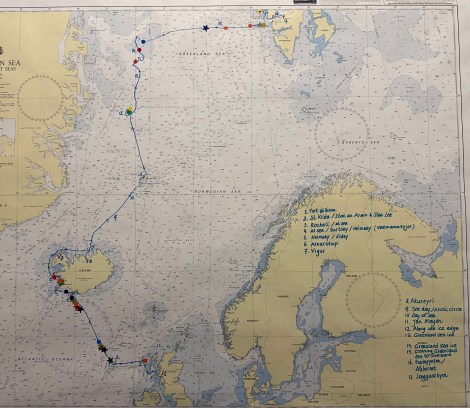
Our route for the next 2.5 weeks – Fort William Scotland to Svalbard
After I arrive in the afternoon, I head to Sauchihall Street in the city center and hit the high spots like Waterstones (book store) to browse and breathe in the woody scent, making up for all the times my priorities were out of order when I was a student in London. I later met up with friends for tea and cake at Mackintosh at the Willow, right next to the bookstore. It was designed by Charles Rennie Mackintosh whose simple interior and intricate ceramic designs were influenced by Japanese art introduced by trade and cultural exchange during the Victorian Era (1851-1910).
Glasgow wasn’t just a center for design, it was also the driver of the industrial revolution in the 19th century. Glass, pottery, ceramics and textiles were manufactured and exported globally in addition to heavy industries such as shipbuilding, engineering and construction. As a result, money and people flooded into the city on the back of constructing ships of all kinds that poured out from Clyde River into the open sea.
The next day, I planned to check out the half marathon route and walk along the river bank lined by former shipyards, foundries and factories. What was once the lifeblood of the city until the Great Depression and World Wars is now packed into the “Riverside Museum of Transport” designed by Zaha Hadid. As China and Japan were advancing their economies, Glasgow lost its glow but still kept the past alive, especially at the Kelvingrove Art Gallery and Museum and the surrounding grounds. The moment I walked in, I was struck by the stunning display of the Pipe Organ in the atrium. I took a turn into the West Court and saw a variety of taxidermy and pondered the ethics of it all. After a quick prayer of thanks that I’ve come across so many of them in the real world, I examined large collections of European paintings. I was instantly drawn to Salvador Dali’s Christ of Saint John of the Cross which exuded a metaphysical vibe on the first floor.


In addition to all the beautiful displays of furniture, ceramics and table ware, tearooms were a significant part of Glasgow’s history. Stuart Cranston, the first tea dealer introduced the concept of tearooms to socialize and get buzzed on tea rather than booze. His sister, Catherine took it up a notch when it was not socially acceptable for women to socialize in pubs or with men in some instances. She was an inadvertent business woman who invited artists to design the furnishings of the tea room and commissioned Mackintosh to design “at the Willow” the last of the tea room branches opened on the high streets. Some of the tea rooms had separate male and female rooms and served steak!
I found the story of Henry and Hornel, two Scottish artists who had a touch of Asian in their art very fascinating. They were part of the Japonisme movement and pursued their art in Japan, a trip funded by Sir William Burrell, son of a wealthy ship owner and collector of the finer things in life. Henry and Hornel were part of the Glasgow Boys, a group of Scottish artists who painted nature and found inspiration from Scottish rural areas. Just like the Francais, they were fascinated by Asian art and themes when Japan opened up for trade in the late 19th century and became a la mode.
I walked to the Botanic Gardens via Kelvin Way and stopped for Napoleon pizza. I ate an entire Margherita building up on my glycogen stores because I planned to walk the half marathon route all while reassuring myself that I wasn’t the only woman who was gobbling down an entire pizza. As soon as I made it to the Botanic Gardens, it rained cats and dogs, so I accidentally walked into Kibble Palace, a glass house where I loitered around a bunch of exotic ferns. I thought of the rich art collector and called an Uber to Pollock Park.


I headed to The Burrell Collection, an ancestral home once owned by the Chancellor of the University of Glasgow, 5 kilometers away from the city center, also part of the half marathon route. The drive seemed endless, I couldn’t imagine running on such undulating terrain as I was being driven around, my mind on the pizza I wolfed down.
I was distracted the moment I saw the modern design of the building. It was an architecture marvel filled with expensive souvenirs and paintings Sir William Burrell and his Lady collected when they were off on their jaunts around the world. He’s been collecting for over 75 years and gifted their collection of 9,000 objects to the city in 1944. My favorites were the tapestries and Asian arts reinforcing my soft spot for all things bright and colorful. It’s definitely a place I would go back to time and again.


 CRAYSCAPE
I love maps, and I am so grateful that you put one at the start of the post of your route. It makes such a difference to place it all in the bigger context of the world, Sarah.
The glimpse of the pizza made me salivate. I think I would have had no problem gobbling the whole thing up either. Thank goodness you love walking. Looks like you had a lovely time exploring Glasgow before setting off on another one of your epic trips.
Thank you.
I’m so fascinated by old maps! On the ship, a remake of one of Abraham Ortelius’s maps from the 1600s was framed. It was amazing to see how lines were drawn back then—so different from what we know today. I wish I had gotten clearer photos of it.